


Agents are rapidly evolving from simple assistants into autonomous actors embedded in real workflows. The question on everyone’s mind is (or should be) “how to manage an ecosystem of hundreds or thousands of agents”. But the challenge isn’t necessarily just about scale, rather it is actually about coordination.
Shared workspaces, a new Agentic Mesh architecture primitive, provides the shared workspace, memory, structure, and security needed to make that coordination possible across huge agent ecosystems.
The closest real-world analogy to shared workspaces is Slack which is a communications platform that provides messaging, collaboration, and information sharing within teams and organizations. But Slack, used by people, works at “people-speed”. Shared workspaces are like Slack for agents that operate in real-time at “agent-speed”, with orders of magnitude faster decision making, interactions, and collaboration.
This article introduces Agentic Mesh shared workspaces and explains how they support enterprise-grade agent collaboration at-scale, and at agent-speed:
Definition of an Agentic Mesh shared workspace
Shared workspace agent classes
How shared workspaces work
Protocol standardization with super contexts
Agentic Mesh Shared Workspaces: Slack for Agents
Slack changed how people collaborate by organizing conversations into channels, making communication more fluid, transparent, and context rich. It replaced the latency and formality of email with real-time, ongoing threads of interaction.
But Slack, like most tools used by people, operates at “people-speed.” Conversations unfold sequentially, responses are constrained by attention spans and working hours, and meaning depends on social cues and nuance.
In contrast, Agentic Mesh shared workspaces are designed to support agent-to-agent collaboration entirely at agent-speed. They extend the core ideas behind Slack—shared space, message channels, persistent state—but remove the human bottlenecks.
Agents don’t need time to think, sleep, or check context. Agents in a shared workspace are ambient, operating in a “headless” way not bound to a user interface. Rather they seamlessly collaborate using a shared communication fabric - they can read, respond, reason, and adapt continuously and in parallel. In a shared workspace, thousands of agents can interact in real time, coordinating activities, execute tasks and share results without waiting for human input or comprehension.
While Slack helps people stay in sync through threads, mentions, and status updates, Agentic Mesh shared workspaces enable agents to dynamically manage shared goals, task hierarchies, and memory based upon shared conversations. An agent doesn’t just drop a message into a channel—it references a secure shared workspace that holds evolving state, past decisions, and active dependencies. Shared workspaces act less like chatrooms and more like a communication fabric where agents interact, collaborate, and do work.
So, let’s think about the implications. What if agents – not bound to a user interface – could collaborate and securely share information at agent-speed, not people-speed? Imagine a world where agents not only interpret context but build on it—refining plans and coordinating execution in milliseconds. As the capabilities of LLMs that power agents get exponentially better and cheaper simultaneously, we are rapidly moving into a world of virtually unlimited, low-cost intelligence that can operate around the clock.
What kinds of work could be reimagined, what kinds of decisions could be made differently or faster, and what kinds of ecosystems could emerge? The shift to agent-speed coordination and collaboration isn’t just about efficiency; It is about coordination and collaboration; It is about agility and speed; But it is really about unlocking entirely new opportunities.
Agentic Mesh’s Shared Workspace: Sharing Agent Context and Conversations
Here is the problem today: most agents today function in isolation, limited by the immediate inputs provided by users – ChatGPT, for example, has people interact directly with a single LLM using a single UX. While this model is OK for simpler interactions, it falls short in scenarios requiring longer-term coordination, distributed work, or multi-step task execution. Without access to a persistent and shared context, agents cannot easily build on one another’s work, resolve interdependencies, or develop collective situational awareness. As a result, collaboration amongst agents remains challenging, fragmented, and brittle.
This architectural limitation is becoming increasingly visible as organizations move beyond isolated agent use cases and begin orchestrating larger, more capable multi-agent ecosystems. What’s clear is that there is an emerging need for a shared memory and coordination layer that can span this diversity and enable coherent multi-agent collaboration. This requirement has given rise to a new agent architectural primitive: Agentic Mesh “shared workspaces”.
Figure 1, Agentic Mesh: Shared Workspace
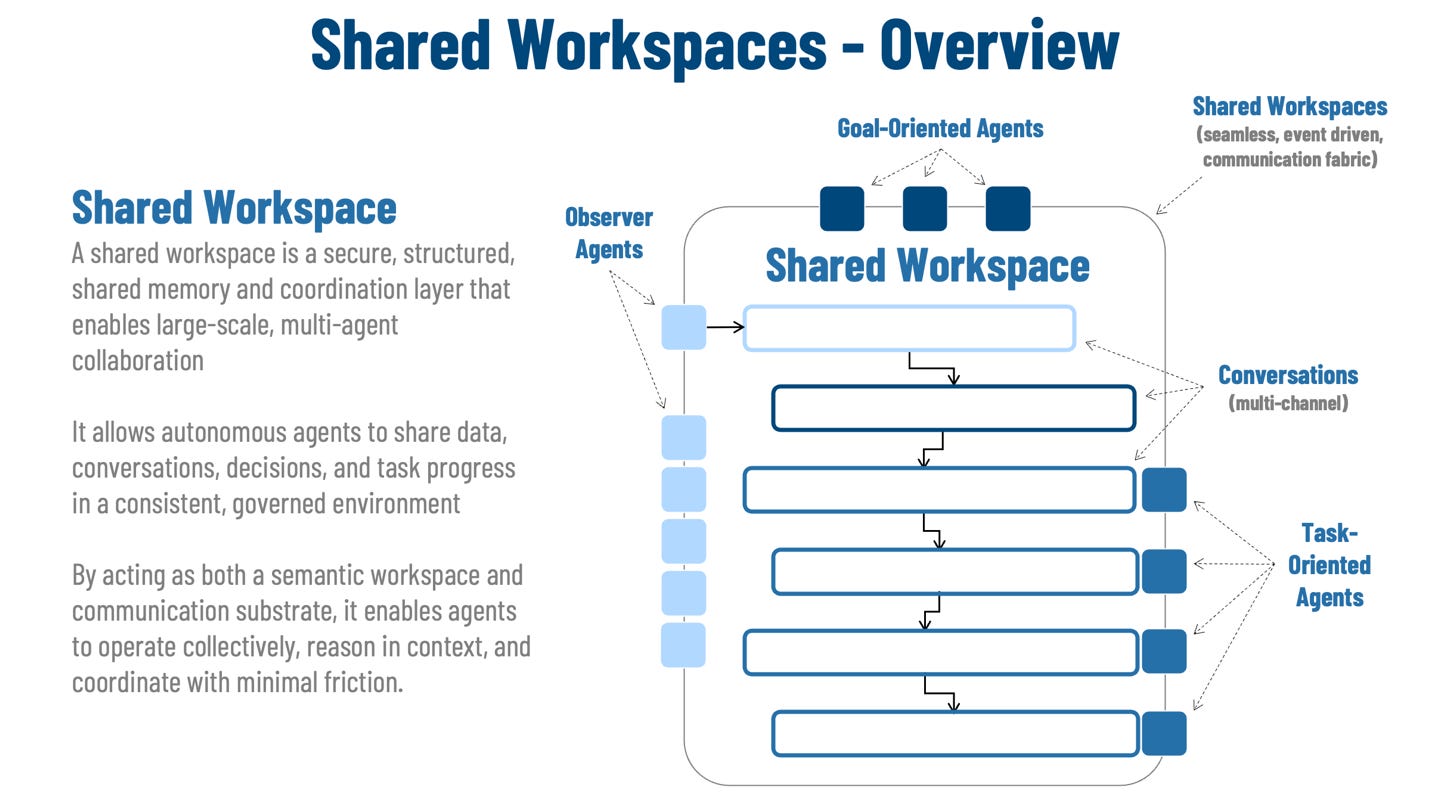
A shared workspace acts as a secure, structured, and persistent shared workspace for agents. It captures and makes available to all participating agents the entire stream of interactions—structured messages, event signals, goals, tasks, intermediate outputs, and outcomes. And it enforces consistency through shared schemas and higher-order semantic protocols (more on that later in the document), ensuring that meaning is preserved across different agents, workflows, and lifecycles. In effect, this makes a shared workspace the agent communication and coordination fabric that supports both real-time and asynchronous collaboration at scale.
An Agentic Mesh shared workspace becomes a semantic layer that encodes the operational logic of the agent ecosystem. It records every interaction – who initiated what, in response to which event, under what conditions – allowing a shared workspace to provide a new level of explainability (what happened in the past) and forward-looking planning (what an agent can do in the future, and how it can do it). Rather than each agent interpreting the interactions in isolation, a shared workspace provides a common conversation history that allows all agents to align their decisions, contribute to shared objectives, and detect inconsistencies or conflicts early in the process.
Since Agentic Mesh shared workspaces come about because of scale, so scalability, of course, is a first-class design goal. Shared workspaces are engineered to support not just dozens, but hundreds or thousands of collaborating agents (what I call agent fleets). Agents in a fleet access a shared workspace in parallel, issuing both ad hoc queries and persistent subscriptions. Pull-based and event-driven workflows coexist, with agents subscribing to conversation threads, hearing all interactions in a conversation, progress markers, or anomaly signals relevant to their tasks.
What distinguishes a shared workspace is its capacity to capture not just isolated messages, but complete chains of interactions and conversations. When agents share entire conversations—including queries, responses, plans, adjustments, and outcomes—they expose the thought process behind decisions. In effect, a shared workspace transforms loosely coupled agents into an ecosystem capable of shared intelligence.
This architecture is fundamentally different from retrieval-augmented generation (RAG) or point-to-point memory modules, or even microservices of the past. RAG systems inject static documents into prompts at inference time, but they do not preserve conversational structure, lineage, or cross-agent semantics. APIs support microservices without the thinking or reasoning that agents have. A shared workspace, by contrast, is not a prompt repository—it is a governed, real-time conversation history that captures everything: agent-to-agent interactions, tool invocations, errors, re-plans, results, and even the results of RAG queries themselves. Literally, it is the system of record for agent behavior.
Interestingly, as agents contribute to a shared workspace over time, their shared conversation – their knowledge base – deepens and improves. Every new insight, interaction, or plan adds to a historical record that future agents can leverage. So, practically, the returns are actually compounding as more agents mean richer memory, better decisions, and more efficient collaboration.
Agentic Mesh Shared Workspace Agent Classes
Agentic Mesh shared workspaces support structured collaboration at scale through a clear division of agent responsibilities. At the core of this design are several primary agent classes – observer agents, task-oriented agents, and goal-oriented agents – each fulfilling a distinct operational role. These agents collectively establish a sensing-deciding-acting loop that enables intelligent, distributed execution across complex workflows.
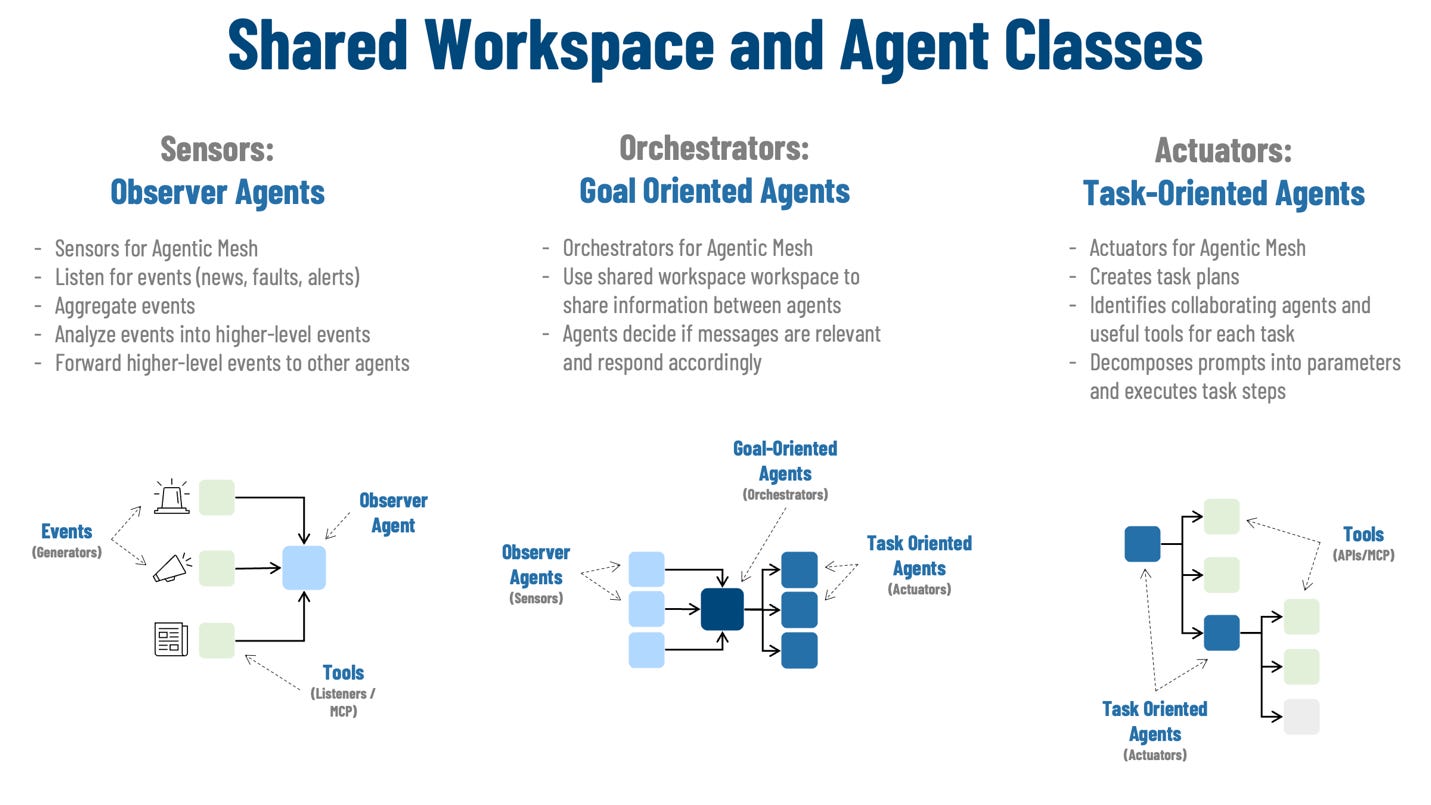
Figure 2, Agentic Mesh: Shared Workspace Agent Classes
Agentic Mesh observer agents serve as the sensors between the external world and the agent ecosystem. Their function is not merely to ingest data, but to transform external inputs—logs, telemetry, market signals, news, alerts—into structured, semantically meaningful events. By processing information at the edge of the ecosystem, observers shield other agents from unnecessary volume and noise, reducing downstream compute and cognitive load.
This preprocessing involves more than basic filtering. Observer agents enrich incoming data streams with contextual metadata, score severity or novelty, use their LLMs for sophisticated reasoning and insight, and even detect shifts in behavior over time. Event windowing and aggregation—performed across time intervals or logical groupings—yield higher-order constructs such as trend indicators or anomaly patterns. These are then written into a shared workspace for use by downstream agents, ensuring consistency, relevance, and traceability.
To support horizontal scale and reduce data duplication, observers are often organized into hierarchies. Local observers operate near high-volume data sources, performing real-time triage. Regional observers synthesize those local signals, extracting thematic or geographic patterns. At the top, global observers integrate across domains, offering a macro-level view of activity across the ecosystem. This layered architecture mirrors principles found in distributed systems—local autonomy combined with global coherence.
Agentic Mesh task-oriented agents are the execution engines within Agentic Mesh. Triggered by goal agents or rule-based policies, they are responsible for performing well-defined actions such as invoking tools, querying databases (or RAG systems), transforming inputs, and submitting outputs.
Task agents write their results—including intermediate outputs, errors, and completion markers—back into a shared workspace. And the results, in-turn, are made available to other agents. This persistent trace allows other agents to reason about system state without requiring direct inter-agent communication. For task-oriented agents, a shared workspace becomes the execution log and state coordination bus for distributed task execution.
Agentic Mesh goal-oriented agents operate at the highest level of abstraction. Their purpose is to coordinate, adapt, and manage long-running, multi-step outcomes – to fulfill goals (as their name implies). These agents construct execution plans by sequencing task-level steps, determining which agents to invoke, and under what triggering conditions. As conditions evolve—whether due to updated observations, partial failures, or changing priorities—goal agents dynamically re-evaluate plans, cancel tasks, or introduce new subtasks. Their decision-making is continuous and stateful.
Because Agent Mesh’s shared workspace encodes a rich history of task execution and observational signals, goal agents can make informed decisions about dependencies, completion status, or blockers. They can identify when progress is stalled, detect divergence from expected paths, and initiate remediation or escalation strategies—all grounded in the full historical and contextual record provided by a shared workspace.
Together, these three classes form a tightly coupled loop: observer agents monitor and interpret external conditions; task-oriented agents create and execute structured plans; and goal-oriented agents coordinate system-wide objectives in response to dynamic context. This modular role specialization, reinforced by the shared memory plane of a shared workspace, is what makes large-scale agent collaboration tractable, testable, and extensible. Much like human organizations evolve roles and teams to handle complexity, agent ecosystems depend on these architectural roles to remain coherent and resilient at scale.
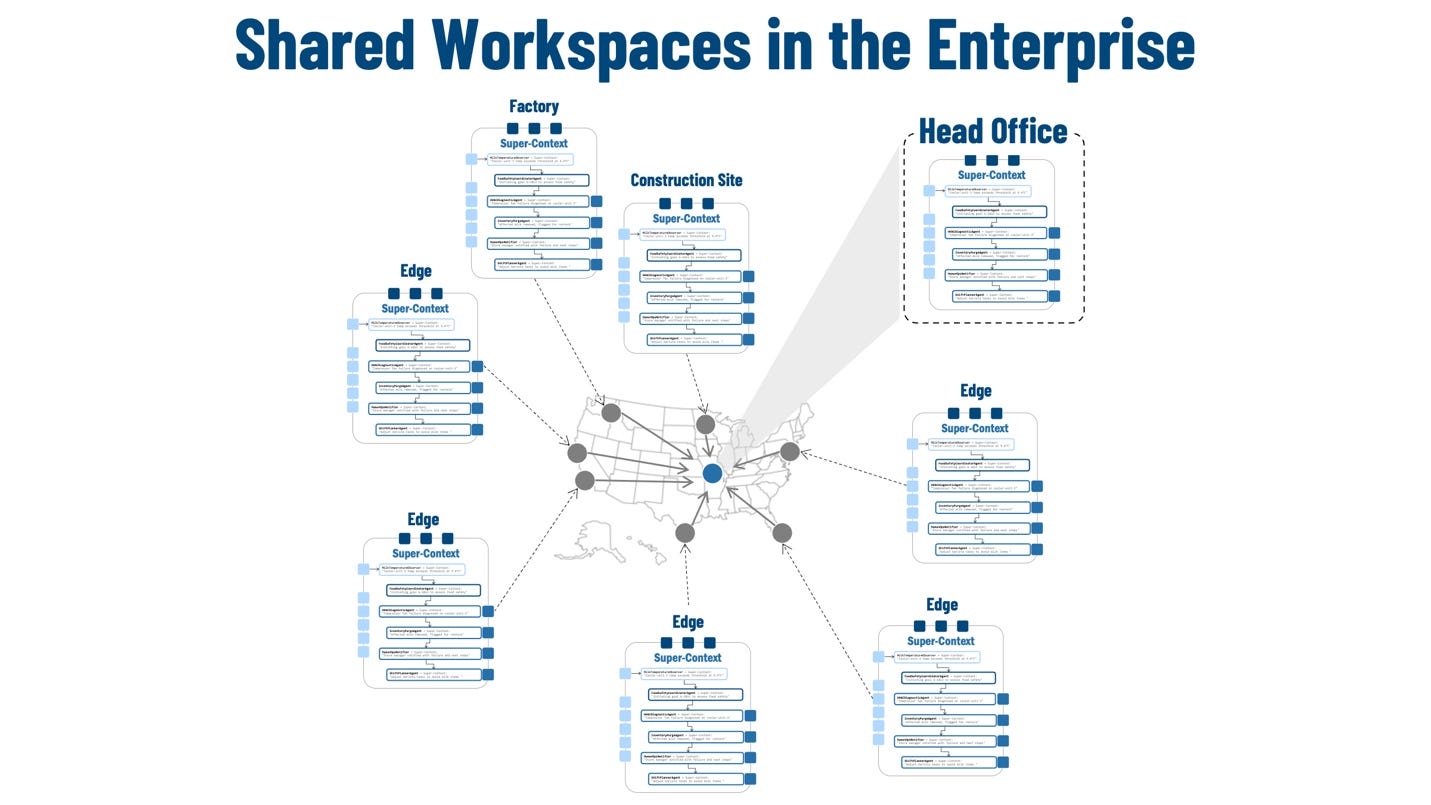
Figure 3, Shared Workspaces in the Enterprise
Agentic Mesh Shared Workspace Orchestration
As multi-agent systems grow from a handful of cooperative agents to fleets operating across functional, geographic, and organizational domains, the mechanics of communication within a shared workspace must evolve to match the complexity and scale of the ecosystem. A shared workspace, by design, is an open workspace that agents can read from and write to, however, without structure and constraints, this openness quickly becomes unsustainable.
In a naive implementation, every agent would be allowed to read every message published to a shared workspace. Each message, whether a status update, a plan revision, or an external signal, would be visible to all agents. If each agent then responds with its own message, and those messages trigger further agent responses, the shared workspace can quickly devolve into a feedback loop of exponential message growth.
To address this, shared workspaces introduce orchestration agents. These orchestrators act as intelligent intermediaries, with visibility into the full set of registered agents, their capabilities, metadata, purpose statements, policy scopes, and conversation history. When a message is published to a shared workspace, the orchestrator reviews it and determines whether it requires agent action—and if so, which agent or subset of agents are best positioned to respond. This targeted routing prevents message flooding and ensures that agent attention is directed where it is most effective. Orchestrators essentially shape the flow of work by aligning messages with agent roles.
Message visibility is further constrained through agent-level access controls, implemented as read filters—white-lists and black-lists—that define which agents can consume messages from which sources. An agent may be configured to accept messages only from trusted peer agents, specific orchestrators, or domain-specific observers. Messages from unauthorized or irrelevant sources are ignored entirely. This mechanism not only limits noise but enforces domain boundaries, privacy scopes, and operational roles within the broader system.
The same mechanics can be composed into layered orchestration. For instance, if an orchestrator identifies a message as a “system” instruction—such as one to start, stop, or reconfigure agents—it routes it to an administrative control agent rather than to a task executor. That administrative agent may operate with elevated permissions and be part of a control plane with access to lifecycle operations. This layered structure allows orchestration logic to distinguish between operational flow (e.g., task execution) and infrastructure flow (e.g., fleet management), using the same underlying message handling rules.
These routing and filtering primitives are powerful enough to form the basis of full communication protocols within a shared workspace. For example, a “compliance review” protocol could involve observer agents tagging risky transactions, an orchestrator routing those to compliance reviewers, and reviewers triggering automated or human escalation depending on severity—all coordinated via structured message flows. Each role operates on its designated subset of messages, and all interactions are logged with provenance, creating a traceable, enforceable workflow without central control logic hardcoded into agents.
So, clearly, communication within a shared workspace is not a free-for-all. In fact, it is a rather disciplined, structured mechanism for managing attention, preserving clarity, and scaling coordination across vast and heterogeneous agent ecosystems. Through orchestrators, message filtering, and role-aware routing, a shared workspace becomes a high-integrity collaboration fabric—capable of supporting both emergent interactions and tightly-governed process automation, all from a single architectural foundation.
Agentic Mesh Shared Workspace and Protocol Standardization
I think the most consequential – and I am sure probably least expected benefit of a shared workspace – is it provides the building blocks for protocol definition and enforcement. A multi-agent ecosystem requires agents to operate with shared expectations about meaning, state, and intent. Shared workspaces address this by serving as not just a coordination fabric but also a semantic layer that ensures agent interactions are interpretable, traceable, and interoperable at scale.
By requiring all agents operating within a given shared workspace to use consistent schemas, it creates the conditions under which structured protocols can be identified. Agents collaborating in a specific shared workspace not only exchange data but do so according to a shared conceptual and semantic model.
So, this does not imply a rigid or global standard. Each shared workspace instance can support its own protocol, tailored to the domain logic, agent types, and operational constraints of its local ecosystem. This architectural flexibility allows for protocol specialization without sacrificing semantic coherence.
In highly regulated domains, protocols embedded within shared workspaces can encode sophisticated semantic models: for example, emissions tracking frameworks in energy, trade lifecycle protocols in capital markets, or jurisdiction-specific compliance workflows in financial crime detection. Because the interaction logic is mediated by a shared workspace—not hardwired into individual agents—protocols can evolve safely. New fields, states, or patterns can be introduced, versioned, and gradually adopted without breaking in-flight collaboration.
Shared workspaces also accommodate the geographic and jurisdictional diversity that large ecosystems must work in. Protocols can incorporate regulatory overlays that dynamically alter behavior based on location, entity type, or data classification. An agent operating within a shared workspace may apply different logging requirements or escalation paths when functioning in the EU versus Canada and adapt its data retention and encryption logic based on residency policies. These behaviors are governed declaratively through a shared workspace’s policy and schema infrastructure, rather than coded manually into every agent instance.
So, shared workspaces really do more than persist conversations and coordinate actions—they create the conditions for semantic interoperability across scale, time, and specialization. They serve as the scaffolding on which interaction protocols can be built, stabilized, and governed. As agent ecosystems grow in complexity, scale, and autonomy, this protocol layer becomes not just helpful but essential. It is what allows collaboration to shift from emergent behavior to deliberate system design, and what ensures that agent communication remains transparent, consistent, and governable in even the most demanding environments.
Agentic Mesh Shared Workspace Protocol
The following is an example of a tiered orchestration protocol inspired by the privilege rings of the Linux kernel which shows how to govern how agents may interact via a shared workspace.
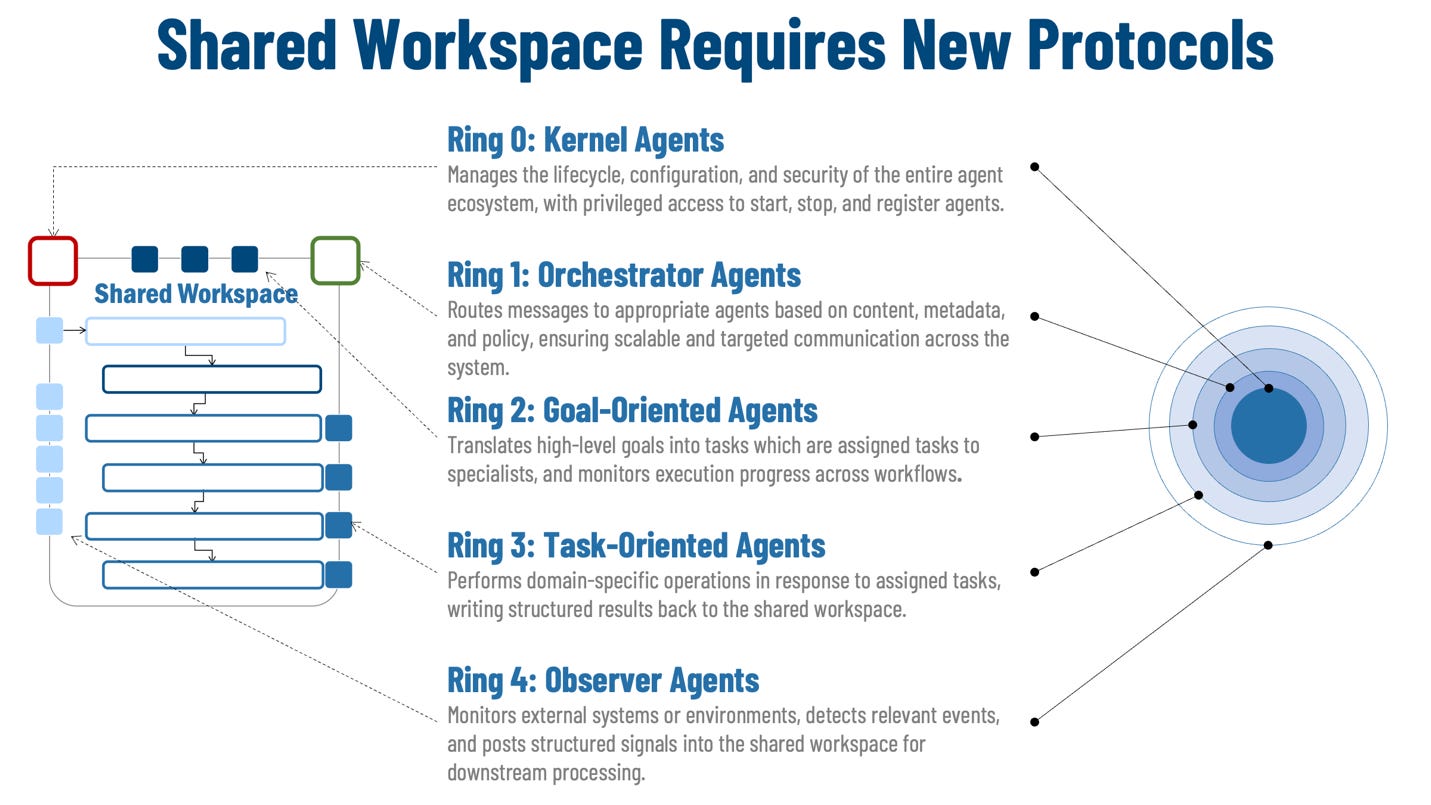
Figure 4, Agentic Mesh: Shared Workspace Protocols
In Linux, Ring 0 is reserved for kernel operations, while user-level processes operate in higher rings with reduced privileges. This same concept can be applied to shared workspace systems.
At Ring 0, we define Kernel Agents responsible for core system operations: starting or stopping agents, managing system-wide configuration, and updating runtime policies. All messages are received first by kernel agents which determine if requests require system-level action. It alone has access to modify the registry of active agents, much like init or systemd in Linux.
All other non-system-level messages would be routed to Ring 1, where we they are intercepted by Orchestrator Agents which have full visibility into agent metadata and message flow. These agents serve as message routers, determining which agents should receive which messages based on purpose, scope, and priority. They rely on declared agent roles, metadata, and message classifications to make routing decisions. Orchestration agents identify the destination for a message and route to destination agents in to Ring 2.
At Ring 2, Goal-Oriented Agents manage multi-step goals or processes. These agents do not perform individual tasks but instead decompose higher-level intents into task plans and assign them to appropriate worker agents. Once worker agents have been identified, messages are routed to Ring 3.
Ring 3 hosts the Task-Oriented Agents, the execution layer of the system. These agents perform bounded, deterministic actions like calling APIs, generating reports, or transforming datasets. They operate with the least privilege—only reading what they need, writing task results, and adhering to strict access controls.
Ring 4 operates somewhat autonomously and hosts long-running Observer Agents, which continuously monitor external systems—logs, sensors, APIs—and summarize new events for the system. They don’t make decisions or act beyond aggregating and analyzing events and reporting results.
By combining these declarations with message routing and role-based access control, the system creates a governed, programmable, and scalable coordination layer—just as the Linux kernel enables user processes to interact safely with hardware and system calls. Where Linux uses syscalls, userspace, and daemons to enforce abstraction boundaries, the shared workspace ecosystem uses orchestration tiers, access protocols, and semantic schemas to manage agents at scale.
This ring-based orchestration protocol example provides both control and flexibility. Kernel agents safeguard the system’s integrity, orchestrators maintain signal routing and workload distribution, coordinators manage goal logic, and task agents execute work—all in a consistent, protocol-governed environment. While the examples above are illustrative, they show how Linux-inspired system design principles can inform a new kind of agent operating model—one not for people or processes, but for intelligent agents collaborating in structured, persistent, shared environments.
Conclusion
Call me biased, but I think shared workspace is a foundational shift in how agent ecosystems coordinate, reason, and scale. It enables structured memory and shared understanding across observer, task, and goal-oriented agents, anchoring collaboration in a common workspace rather than brittle point-to-point messages. We explored how shared workspaces enforce protocol-level consistency, support fine-grained security and governance, and enable robust abstractions for multi-agent planning and execution. From operational responsiveness to strategic forecasting, and from modular composability to institutional memory, a shared workspace redefines what it means for agents to work together effectively.
Agentic Mesh’s shared workspace seems more than a technical enabler. It unlocks new models for dynamic collaboration, long-lived autonomy, and cross-domain intelligence. With the right design, organizations can build ecosystems where agents don’t just assist, but participate—contributing to collective goals, adapting to new contexts, and improving over time. In doing so, a shared workspace becomes not just a coordination layer, but a catalyst for scalable, intelligent systems capable of solving increasingly complex, interconnected problems.
***
Feel free to reach out and connect with the author Eric Broda on LinkedIn. Questions and comments are welcome and encouraged!
***
This is part of larger article that addresses a broader suite of topics related to agents (see my full article list). If you like this article, you may wish to checkout an upcoming book, “Agentic Mesh”, with O’Reilly, and soon on Amazon.
***
All images in this document except where otherwise noted have been created by Eric Broda. All icons used in the images are stock PowerPoint icons and/or are free from copyrights.
The opinions expressed in this article are that of the authors alone and do not necessarily reflect the views of our clients.
Thanks for reading AgenticMesh Substack! Subscribe for free to receive new posts and support my work.
Looking for more?
👉 Discover the full O’Reilly Agentic Mesh book by Eric Broda and Davis Broda
🎧 Follow The Agentic Mesh Podcast on Youtube, Spotify and Apple Podcasts. A new video every week!